Full Stack Development Course in Alambagh
Web applications have become an essential part of modern businesses, online services, e-commerce platforms, educational systems, and digital products. Behind every successful web application, both the visible user interface and the server-side system need to work together efficiently. Learning both sides of web development can give students a broader understanding of how complete web applications are created.
The Full Stack Development Course in Alambagh offered by Hanumant Technology Pvt Ltd is designed for students, graduates, beginners, working professionals, and aspiring developers who want to build practical web development skills. The course introduces learners to front-end development, back-end programming, databases, APIs, application logic, and complete website development.
Hanumant Technology Pvt Ltd provides practical Full Stack Development Training in Alambagh with an emphasis on hands-on learning. Students get opportunities to work on coding exercises and projects so they can understand how individual technologies come together to create functional web applications.
Contact Us Now
What does Full Stack Development Coaching in Alambagh include?
Our Full Stack Development Coaching in Alambagh covers the different layers involved in developing modern web applications. Students first understand how websites work and then move toward front-end interfaces, server-side programming, databases, and application integration.
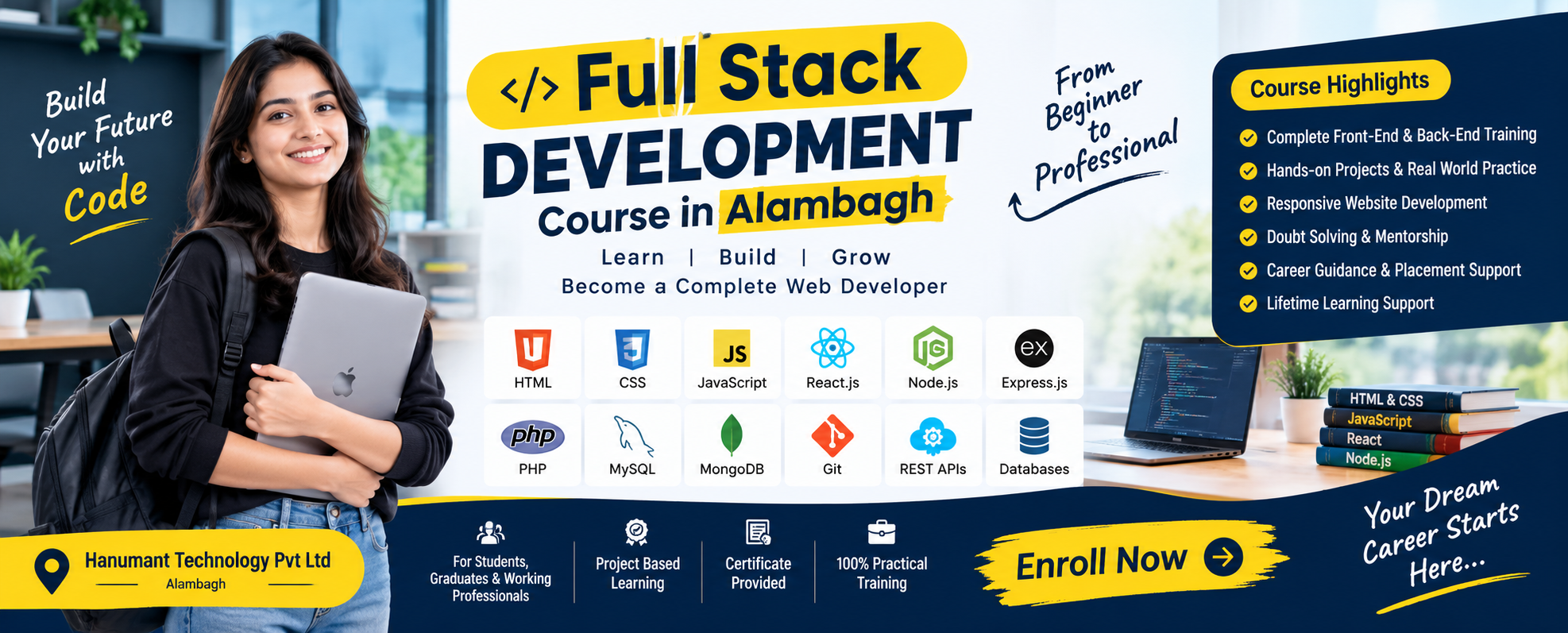
The Full Stack Development Course in Alambagh may include technologies such as HTML, CSS, JavaScript, React.js, Node.js, Express.js, PHP, MySQL, MongoDB, REST APIs, Git, and other development tools depending on the selected learning path.
The training focuses on writing code, understanding application structure, handling data, connecting different components, debugging problems, and developing responsive web applications.
Full Stack Development Syllabus in Alambagh
The curriculum is designed to take learners from basic web concepts toward complete application development.
HTML and CSS
HTML provides the basic structure of a webpage, while CSS controls its appearance and layout. Students learn how to create webpage structures, forms, navigation sections, cards, tables, and other interface components.
CSS concepts such as responsive layouts, positioning, spacing, typography, Flexbox, and Grid are also introduced to help learners create websites that work across different screen sizes.
JavaScript
JavaScript adds functionality and interaction to websites. Students learn variables, functions, conditions, loops, arrays, objects, events, DOM manipulation, asynchronous programming, and other important concepts.
Practical coding exercises help students understand how JavaScript can be used to create dynamic web experiences.
Front-End Development
Students learn how modern user interfaces are planned and developed. Depending on the training path, learners may work with frameworks and libraries such as React.js.
They learn components, props, state management concepts, events, forms, routing, API integration, and other techniques used in modern front-end development.
Back-End Development
Back-end development manages server-side operations and application logic. Students learn how servers process requests, communicate with databases, authenticate users, and send information to the front end.
Technologies such as Node.js and Express.js may be introduced for building server-side applications and APIs.
Database Management
Web applications often need to store and retrieve user and business information. Students learn database concepts and work with technologies such as MySQL and MongoDB.
Training can include tables, relationships, queries, CRUD operations, database design, data retrieval, and connecting databases with web applications.
REST APIs
APIs allow different parts of an application to communicate with each other. Students learn the fundamentals of creating and consuming APIs and understand methods such as GET, POST, PUT, and DELETE.
Git and Version Control
Students are introduced to Git and version control concepts so they can manage code changes, maintain project versions, and understand collaborative development workflows.
Benefits of Full Stack Development Training in Alambagh
Complete Development Knowledge
The Full Stack Development Training in Alambagh helps learners understand both front-end and back-end development instead of concentrating on only one side of a web application.
Practical Coding Experience
Students practice coding through exercises and projects. This approach helps them understand how programming concepts are used to solve actual development problems.
Responsive Website Development
Learners understand how websites can be designed to work across desktops, tablets, and mobile devices. Responsive design concepts are included as part of front-end development.
Project-Based Learning
Building complete applications gives students an opportunity to combine HTML, CSS, JavaScript, front-end frameworks, server-side programming, APIs, and databases in a single project.
Doubt Solving
Students can discuss programming errors and development-related questions with trainers. Step-by-step explanations help learners understand concepts instead of simply copying code.
Portfolio Development
Completed projects can become part of a developer portfolio. A practical portfolio can help demonstrate coding abilities during internships, job applications, freelance opportunities, or client discussions.
Objectives of Full Stack Development Course in Alambagh
The main objective of our Full Stack Development Course in Alambagh is to help learners understand the complete process of developing modern web applications.
Students learn how a website begins with a user interface and connects to server-side logic and databases to provide complete functionality.
The course also aims to improve programming logic and problem-solving abilities. Learners practice writing code, identifying errors, debugging applications, handling data, and integrating different technologies.
Another objective is to familiarize students with development workflows used in professional environments, including project organization, APIs, databases, version control, testing, and deployment fundamentals.
Practical Full Stack Development Projects
Projects form an important part of our Full Stack Development Training Institute in Alambagh. Students can apply different technologies while creating complete applications.
Projects may include:
- Personal Portfolio Website
- Responsive Business Website
- Student Management System
- Online Shopping Website
- Blog Management System
- E-Commerce Application
- Employee Management System
- Online Booking Application
- Learning Management Website
- Customer Management System
- REST API Project
- Authentication-Based Web Application
- Database-Driven Website
These projects help learners understand how individual modules are connected to create a functional application.
Who Can Join Full Stack Development Training in Alambagh?
The Full Stack Development Course in Alambagh can be suitable for:
- College Students
- Engineering Students
- Graduates
- Diploma Students
- Beginners
- Working Professionals
- Freelancers
- Aspiring Web Developers
- Entrepreneurs
Students from non-technical backgrounds can also begin with fundamental programming and web concepts before progressing toward advanced development topics.
Why Choose Full Stack Development Training in Alambagh?
Choosing a suitable Full Stack Development Training Institute in Alambagh can help learners follow a structured path toward becoming web developers. Hanumant Technology Pvt Ltd focuses on practical and career-oriented IT training.
The training combines programming fundamentals with project development so learners can understand how different technologies interact inside a real application.
Students receive trainer guidance while practicing coding, working with databases, integrating APIs, and developing projects. The learning process is designed to encourage practical experimentation and problem-solving.
Along with Full Stack Development Course in Alambagh, Hanumant Technology Pvt Ltd also provides professional courses in Web Development, Digital Marketing, Data Science, Data Analytics, Artificial Intelligence, Graphic Designing, Video Editing, AutoCAD, Python, Java, and other IT-related fields.
Career Opportunities After Full Stack Development Course
After completing a Full Stack Development Course in Alambagh, learners can explore different technology roles depending on their skills and experience.
Potential career options include:
- Full Stack Developer
- Front-End Developer
- Back-End Developer
- Web Developer
- React Developer
- Node.js Developer
- Junior Software Developer
- PHP Developer
- Application Developer
- Web Development Intern
Full Stack Developers can find opportunities in software companies, startups, IT service organizations, e-commerce businesses, digital agencies, and companies developing their own web-based products.
Freelancing is another possible path where developers can work on websites, web applications, APIs, business portals, and customized software projects.
Enroll in Full Stack Development Course in Alambagh
If you are searching for a practical Full Stack Development Training Institute in Alambagh, Hanumant Technology Pvt Ltd can help you build a strong foundation in modern web development.
The training covers front-end development, JavaScript, frameworks, back-end programming, databases, APIs, version control, responsive design, and practical application development.
To know more about Full Stack Development Course Fees in Alambagh, course duration, syllabus, batch timings, certification, projects, and admission details, contact the Hanumant Technology training team.
Start learning Full Stack Development in Alambagh and develop the skills required to create complete, functional, and modern web applications.
Frequently Asked Questions (FAQs)
1. What is Full Stack Development?
It involves developing both the front end and back end of web applications.
2. What topics are covered in the course?
The course covers HTML, CSS, JavaScript, databases, APIs, and back-end development.
3. Who can join the Full Stack Development course?
Students, graduates, beginners, and working professionals can join.
4. Can beginners learn Full Stack Development?
Yes, beginners can start with basic programming and gradually learn advanced concepts.
5. Which technologies are taught in Full Stack Development?
Technologies may include HTML, CSS, JavaScript, React, Node.js, MySQL, and MongoDB.
6. Does the course include practical projects?
Yes, learners can practice by developing websites and database-driven web applications.
7. What career options are available after the course?
Career options include Full Stack Developer, Web Developer, Front-End Developer, and Back-End Developer.
8. Is JavaScript important for Full Stack Development?
Yes, JavaScript is widely used for interactive front-end and server-side development.
9. What are the Full Stack Development course fees?
Fees depend on the course duration and curriculum. Contact Hanumant Technology for details.
10. How can I enroll in the course?
Contact Hanumant Technology for admission details, course fees, and batch timings.